Understanding the European Laundry vs Laundry Room Concept
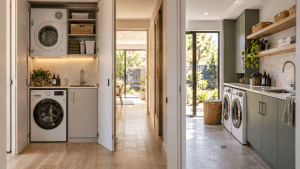
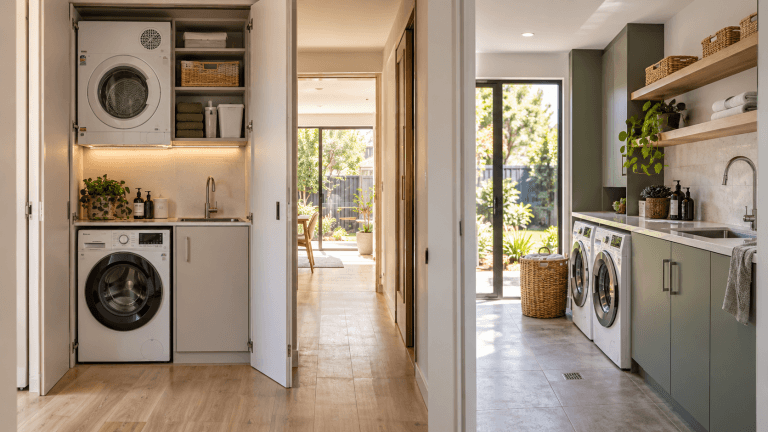
A European laundry is a space-saving design where the washing machine, dryer, and laundry tub are concealed behind cabinetry or bi-fold doors, typically within a hallway, kitchen, or bathroom. In contrast, a dedicated laundry room is a separate, enclosed space designed exclusively for washing, drying, ironing, and storage. At Everest Kitchen, Bathrooms & Plumbing, we often help clients weigh these options based on their lifestyle and property constraints.
Space Efficiency and Layout Strategy
For many Melbourne homeowners, floor space is a premium commodity. A European laundry is the gold standard for apartment living or homes with limited square footage. By integrating your laundry into an existing room, you reclaim valuable floor space that would otherwise be dedicated to a single-purpose room. However, this requires precise joinery to ensure that the appliances fit perfectly while leaving room for plumbing access. When designing these, consider the ‘work triangle’—the path between your washer, dryer, and folding bench. A dedicated room allows for a linear, L-shaped, or U-shaped layout that maximises efficiency, whereas a European laundry is almost always a linear, stacked, or side-by-side configuration.
Ventilation and Moisture Management
One of the most critical factors in laundry design is moisture management. Because European laundries are often tucked into cupboards, ventilation is paramount. You must ensure that your dryer is either vented externally or that the cupboard space is sufficiently large and ventilated to prevent mould growth. Our team often recommends high-quality condenser or heat-pump dryers for these installations to minimise moisture output. In a dedicated laundry room, you have the advantage of windows and exhaust fans, which are standard requirements for wet areas under the National Construction Code (NCC) to ensure adequate air exchange. Without proper ventilation, the humidity trapped in a cupboard can lead to long-term damage to your cabinetry and surrounding walls.
Noise and Acoustic Control
Noise is a major differentiator. A dedicated laundry room allows you to close the door on the sound of a spin cycle, whereas a European laundry—often located near living areas or bedrooms—can be disruptive. If you choose a European design, investing in high-quality, quiet-operation appliances and sound-dampening cabinetry is a worthwhile investment. Consider using soft-close hinges and acoustic seals around the door frames to mitigate vibration and noise transmission. For those in apartments, checking the acoustic rating of your wall partitions is also a wise step to ensure your laundry habits do not disturb neighbours.
Storage and Daily Functionality
The primary advantage of a dedicated laundry room is the ability to incorporate extensive storage. From tall cupboards for ironing boards and mops to overhead shelving for detergents, a separate room acts as a command centre for household chores. A European laundry, by definition, is more limited. You may find yourself needing to store laundry baskets and cleaning supplies elsewhere, which can clutter your living spaces. If you opt for a European laundry, consider ‘hidden’ storage solutions like pull-out hampers or vertical shelving units that utilise the full height of the cupboard. Maximising vertical space is the key to making a compact European laundry feel functional.
Budgeting for Your Renovation
Renovation costs in Victoria vary significantly based on the scope of work. A basic refresh might range from $3,000 to $8,000, while a comprehensive, high-end fitout can exceed $30,000. Whether you choose a European or dedicated layout, the plumbing and electrical requirements remain the biggest cost drivers. Moving water lines or upgrading power circuits for modern appliances requires licensed professionals. A mid-range renovation in the outer suburbs typically costs $7,000 to $14,000, compared to $9,000 to $16,000 in inner Melbourne, reflecting higher trade rates and the complexity of older building structures. We encourage you to book a consultation to discuss how your specific layout impacts your budget. Remember to factor in the cost of waterproofing, which is mandatory for all wet areas in Australia.
Common Mistakes to Avoid
- Underestimating Ventilation: Failing to provide adequate airflow in a European laundry leads to mould and damage to cabinetry.
- Poor Plumbing Access: Ensure that shut-off valves and drainage points are accessible without needing to dismantle the entire joinery unit.
- Ignoring Appliance Dimensions: Always check the specific depth and height of your chosen washer and dryer, including the space required for hoses and power plugs at the rear.
- Inadequate Waterproofing: Even in a European laundry, the floor area must be properly waterproofed to meet Australian standards for wet areas.
- Overlooking Lighting: Ensure your laundry area has task lighting, especially if it is tucked into a dark cupboard or hallway.
Key Comparison Summary
| Feature | European Laundry | Dedicated Laundry Room |
|---|---|---|
| Space | Highly efficient | Requires dedicated footprint |
| Storage | Limited | High capacity |
| Noise | Higher impact | Easily contained |
| Ventilation | Requires careful planning | Standard window/fan |
Professional Installation and Compliance
Regardless of the style you choose, all laundry renovations must comply with the National Construction Code (NCC) and local Victorian plumbing standards. This includes proper waterproofing, correct fall for floor wastes, and appropriate electrical safety measures. Engaging a professional team ensures that your project is not only aesthetically pleasing but also safe and compliant. Our plumbing services are designed to integrate seamlessly with your cabinetry and joinery, ensuring a stress-free renovation experience. Always request a Certificate of Electrical Safety (CES) and a plumbing compliance certificate upon completion of the works.
Decision Criteria: Which Should You Choose?
Choose a European laundry if you live in an apartment, have a small floor plan, or rarely use the laundry for anything other than washing and drying. It is the perfect solution for minimalist homes where every square metre counts.
Choose a dedicated laundry room if you have a large family, require space for ironing, pet washing, or storage of bulk cleaning supplies, and if you have the floor space to spare. It adds significant value to family homes by keeping the ‘mess’ of laundry contained.
Frequently Asked Questions
Is a European laundry cheaper to install?
Not necessarily. While you save on square footage, the cost of custom joinery to hide appliances and the need for specialised ventilation can make a European laundry comparable to a standard laundry room renovation. You are essentially paying for high-quality cabinetry to conceal the utility area.
Do I need a permit for a laundry renovation?
In Victoria, most internal renovations do not require a building permit unless you are moving structural walls or significantly altering the building’s footprint. However, all plumbing and electrical work must be performed by licensed professionals who provide the necessary compliance certificates to ensure your home remains insurable and safe.
How do I manage moisture in a European laundry?
We recommend using a heat-pump dryer, which is more energy-efficient and produces less heat and moisture than traditional vented dryers. Additionally, ensuring the cabinetry has adequate airflow gaps and using moisture-resistant board (MR board) for the joinery is essential for preventing mould growth.
Can I convert a dedicated laundry into a European laundry?
Yes, this is a common strategy for homeowners looking to repurpose space. By removing the laundry room walls, you can open up the floor plan, though this will require re-routing plumbing and electrical services. It is a great way to create a larger kitchen or a secondary bathroom.
What is the most important factor in a laundry renovation?
Functionality and waterproofing are paramount. Ensure your layout allows for easy access to the washing machine and that all wet areas are properly waterproofed to prevent long-term structural damage. A well-planned laundry should also account for the ‘work triangle’ to make chores more efficient.